How RingOwl went from 0% to 3% AI visibility in one month
As a brand-new product, RingOwl was invisible to the AI tools our own customers use every day — a flat 0%. Here's what we did, in what order, and what it actually moved.
Updated 2026-08-05 · Written by RingOwl, an AI answering service — our bias is disclosed in every section that mentions us
The short answer
When RingOwl — a brand-new AI answering service — ran its first AI visibility scan with GetIntel, the score came back 0%: not recommended once by ChatGPT, Perplexity, Gemini, or Google AI Overview on any buyer prompt in its category. The cause wasn't weak content; it was a trust gap. A new domain with no backlinks and no authority gives AI models nothing to anchor a recommendation to, and in this category 76% of citations already go to corporate sites and 16% to competitors. The fix was sequenced deliberately: build the trust layer first — earn real backlinks and lift domain rating — then work through GetIntel's concrete task list of articles to publish and Reddit threads to join, aimed at the thin 7% slice of citations (user-generated content) actually within reach of a new entrant. Over one month, that took RingOwl from 0% to 3% blended AI visibility and onto the category leaderboard at #11. Small in absolute terms, but going from a complete shutout to appearing in the conversation in 30 days is the signal: work the right levers in the right order, and even a brand-new product starts moving.
- 1GetIntel's launch scan put RingOwl at 0% AI visibility — not mentioned once across ChatGPT, Perplexity, Gemini, and Google AI Overview on any buyer prompt in the category.
- 2The cause was a trust gap, not a content gap: a brand-new domain with no backlinks gives AI models nothing to anchor a recommendation to.
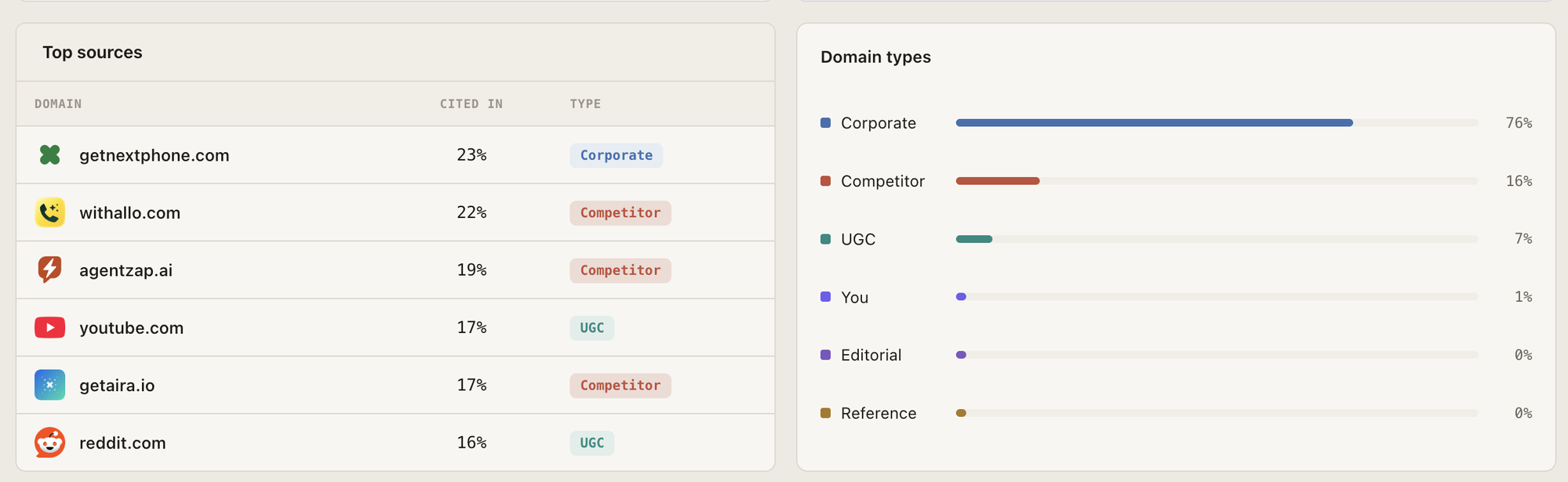
- 3In the category's citations, 76% went to corporate sites and 16% to competitors — RingOwl's own domain was roughly 1% of everything cited.
- 4The fix ran in order: earn backlinks and domain authority first, then execute GetIntel's article + Reddit task list aimed at the reachable 7% UGC slice.
- 5One month later, blended AI visibility moved from 0% to 3% and RingOwl entered the leaderboard at #11.
How we found out we were invisible
GetIntel ran buyer-intent prompts against the AI answering and small-business phone-automation category. Across ChatGPT, Perplexity, Gemini, and Google AI Overview, RingOwl didn't show up once. The reason was simple: as a new product, there was nothing yet that told these models we were a real, credible business worth recommending.
Looking at who does get cited made the gap concrete. The AI answers pulled from a handful of specific domains — getnextphone.com, withallo.com, agentzap.ai, getaira.io — plus YouTube and Reddit for the more community-driven answers. By domain type, 76% of citations came from corporate sites, 16% from competitors, and just 7% from user-generated content like Reddit and YouTube. RingOwl's own domain accounted for roughly 1% of anything cited anywhere in the category.
It was a trust gap, not a content gap
This wasn't a content problem first — it was a foundational trust problem. A brand-new domain with no backlinks and no established authority gives AI models nothing to anchor a recommendation to, no matter how good the product actually is.
And with corporate and competitor domains owning 92% of citations between them, we were up against a category where the incumbents' own sites were doing most of the talking.
The competitive landscape
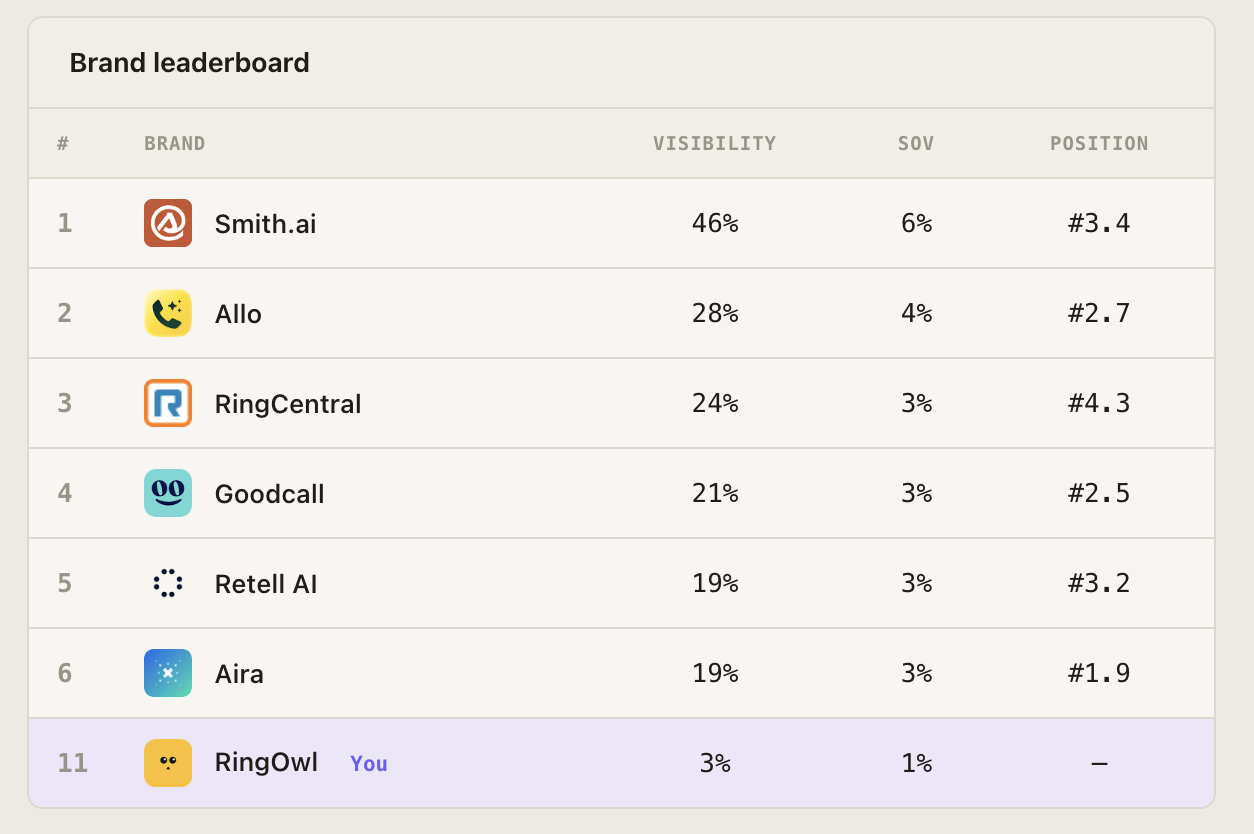
The leaderboard made the shape of the category clear. Smith.ai led at 46% visibility and 6% share of voice, followed by Allo (28%, 4%), RingCentral (24%, 3%), Goodcall (21%, 3%), Retell AI (19%, 3%), and Aira (19%, 3%). RingOwl sat at #11: 3% visibility, 1% share of voice.
Two things stood out. First, visibility and position aren't the same signal — Aira had less than half of Smith.ai's visibility but the best average position on the board (#1.9 vs #3.4), meaning when AI did mention Aira it tended to lead with it rather than bury it further down. Second, three competitors — Allo, Retell AI (via agentzap.ai), and Aira — weren't just winning brand mentions; their own domains showed up directly in the top cited sources. They were getting cited twice over: once as the recommended brand, once as the source backing the recommendation. That compounding advantage — domains AI already trusts enough to cite as evidence — is what a new entrant is really competing against.
What we fixed, in order
We tackled this in two stages, and the order mattered.
First, the trust layer. Before touching content, we worked on earning real backlinks and increasing our domain rating — the baseline signal that tells AI models a domain is established and worth citing rather than a placeholder site.
Then the task list. Once the trust foundation was in place, GetIntel laid out specific actions: publish articles targeting the right topics, and get active in the relevant Reddit threads where our category gets discussed — aimed directly at that thin 7% UGC slice, since Reddit was already one of the few non-corporate sources AI was citing at all. Our team worked through the list.
The result: 0% to 3% in a month
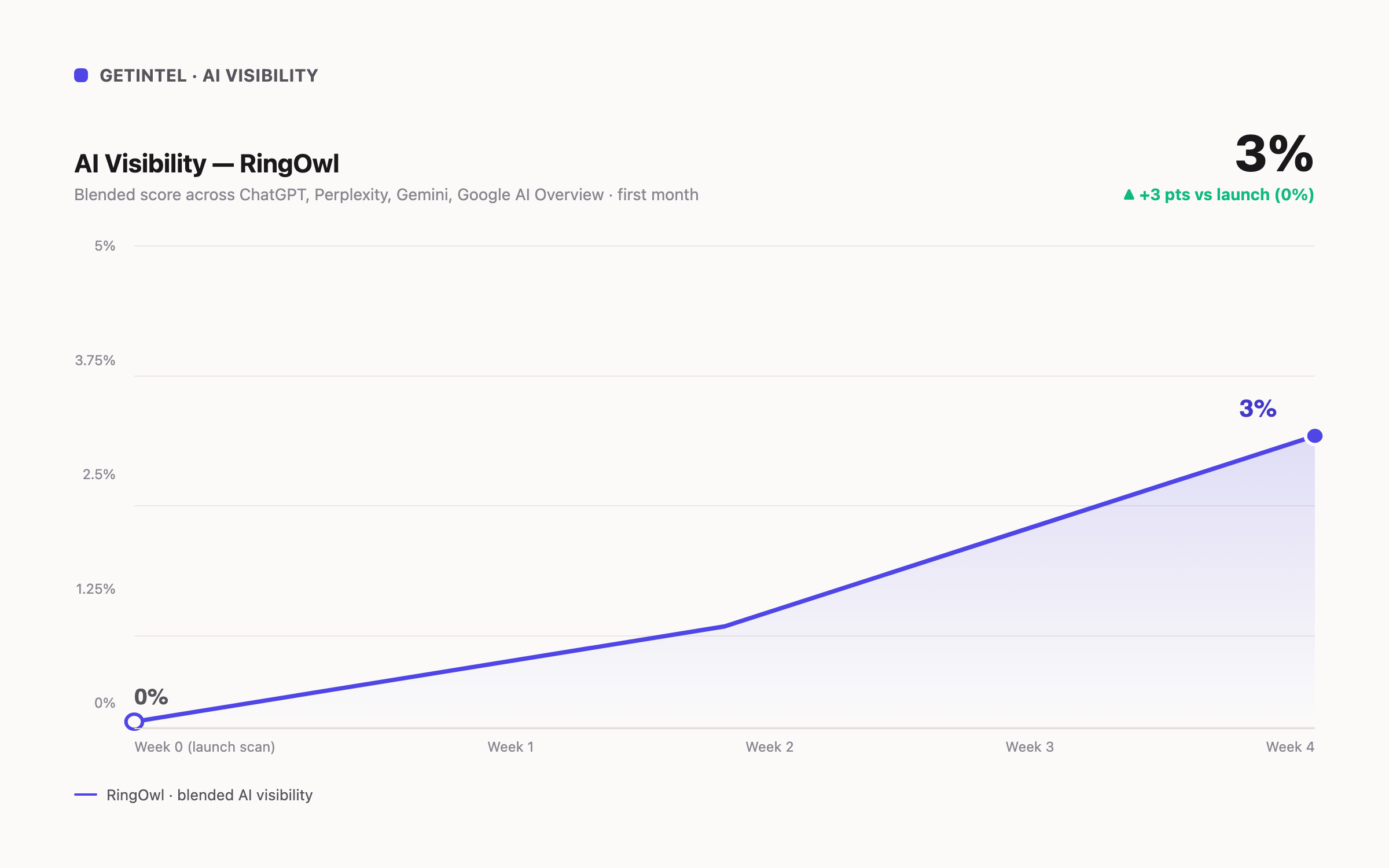
Over one month, that combination took RingOwl from 0% to 3% blended AI visibility.
Checked against the category leaderboard, that puts RingOwl at #11 — still well behind Smith.ai (46%), Allo (28%), RingCentral (24%), Goodcall (21%), Retell AI (19%), and Aira (19%), the incumbents who between them still capture most of the category's citations.
On its own, 3% doesn't sound like much. But going from a complete shutout — not considered at all — to actually appearing in the conversation in a month is the real signal: work the right levers in the right order, and even a brand-new product starts moving.
The takeaway
Zero to something is the hardest part of this. It proves the direction is right before it proves the scale is. For a new business, the sequence mattered: earn the trust signals first, then do the content and community work — not the other way around — and aim that work at the specific slice of citations, like UGC, that's actually within reach of a new entrant.
The other part that mattered to us: as a small, new business ourselves, GetIntel's pricing was something we could actually afford, and instead of vague advice the platform gave us an actual task list to execute against. Affordable and actionable is why we kept using it after the first month.
Questions
Common questions
What is AI visibility?+
AI visibility measures how often — and how prominently — an AI assistant like ChatGPT, Perplexity, Gemini, or Google's AI Overview recommends your business when someone asks a buying question in your category. GetIntel scores it by running buyer-intent prompts across those engines and checking whether your brand appears, where in the answer it lands, and which sources the answer cites. A 0% score means you're never mentioned; a leaderboard shows how you rank against competitors.
Why was RingOwl at 0% AI visibility?+
Because it was new. A brand-new domain with no backlinks and no established authority gives AI models nothing to anchor a recommendation to. It wasn't a content or product problem first — it was a trust gap. In RingOwl's category, 76% of citations already go to corporate sites and 16% to competitors, so the incumbents' own domains were doing most of the talking.
How did RingOwl improve its AI visibility?+
In two stages, in order. First it built the trust layer: earning real backlinks and lifting its domain rating so models would treat the site as established rather than a placeholder. Then it worked through GetIntel's concrete task list — publishing articles on the right topics and getting active in relevant Reddit threads — aimed at the 7% of citations coming from user-generated content, the slice most reachable for a new entrant.
How long did it take to go from 0% to 3%?+
One month — four weeks from the launch scan (week 0) to week 4. Blended AI visibility across ChatGPT, Perplexity, Gemini, and Google AI Overview rose steadily over that period, moving RingOwl onto the category leaderboard at #11 with 3% visibility and 1% share of voice.
Is 3% AI visibility good?+
In absolute terms, no — it's still well behind Smith.ai (46%), Allo (28%), and RingCentral (24%). But going from a complete shutout to appearing in the conversation at all, in a month, is the point. Zero to something proves the direction is right; scale comes after. The lesson is sequence: earn trust signals first, then do the content and community work, aimed at the citations within reach.
Keep reading
Related guides
Hear it answer as your business
Seven days free, 30 minutes included, no credit card. You get a test number to call so you can hear how RingOwl handles your calls before you pay anything.